
Heading for disaster
Total loss of confidence.

Remember that period after the 2016 presidential election, when a bunch of reporters convinced themselves that we were entering a new golden age of journalism?
It feels like 100 years ago.
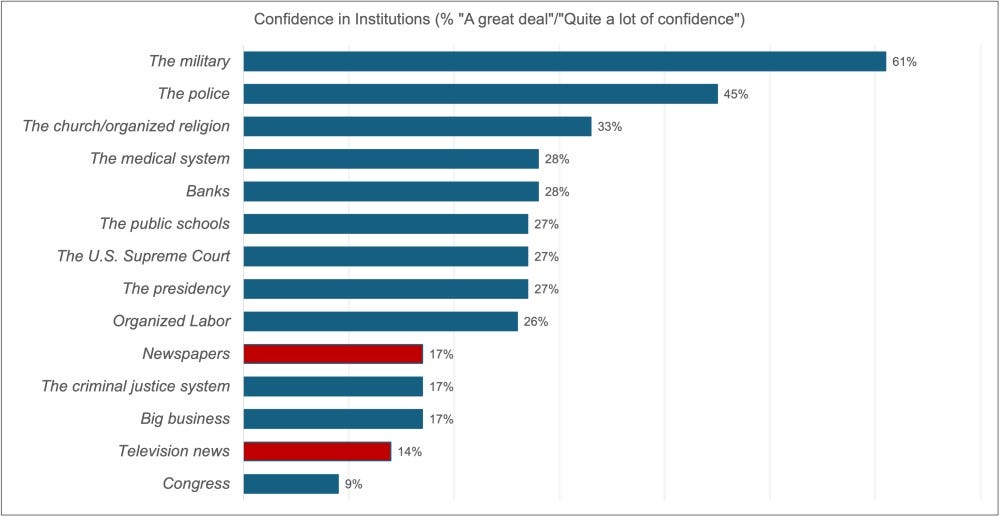
Today, back in reality, the news media rank among the least-trusted institutions in the United States, according to new Gallup polling.
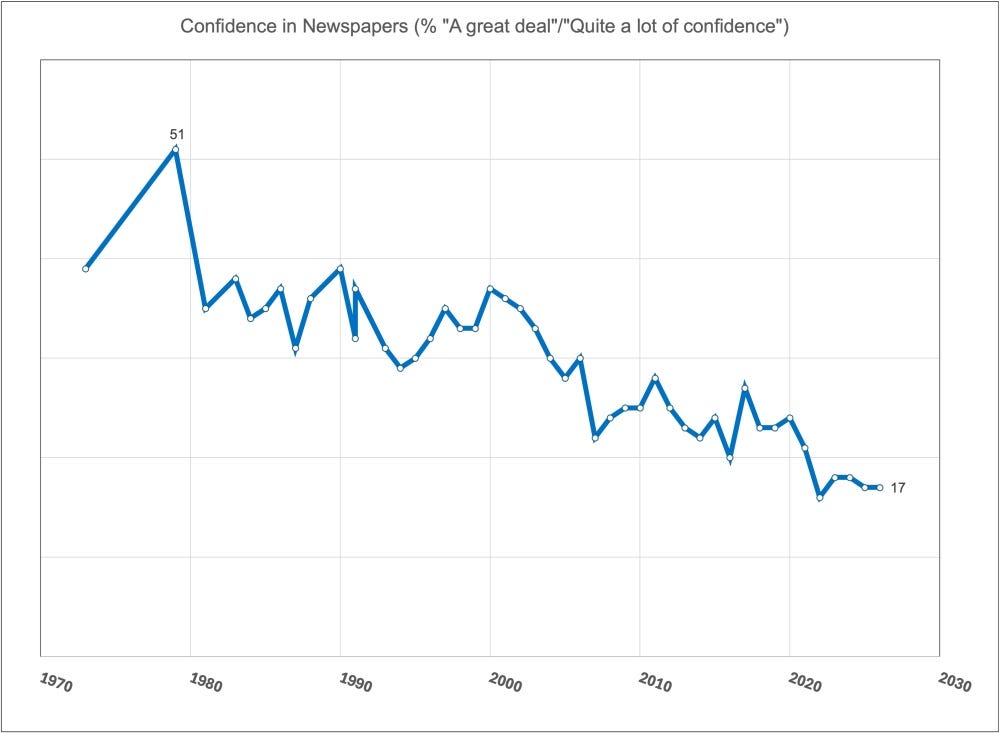
Only 17 percent of Americans say they have “a great deal” or “quite a lot” of confidence in newspaper reporting, down one point from last year.
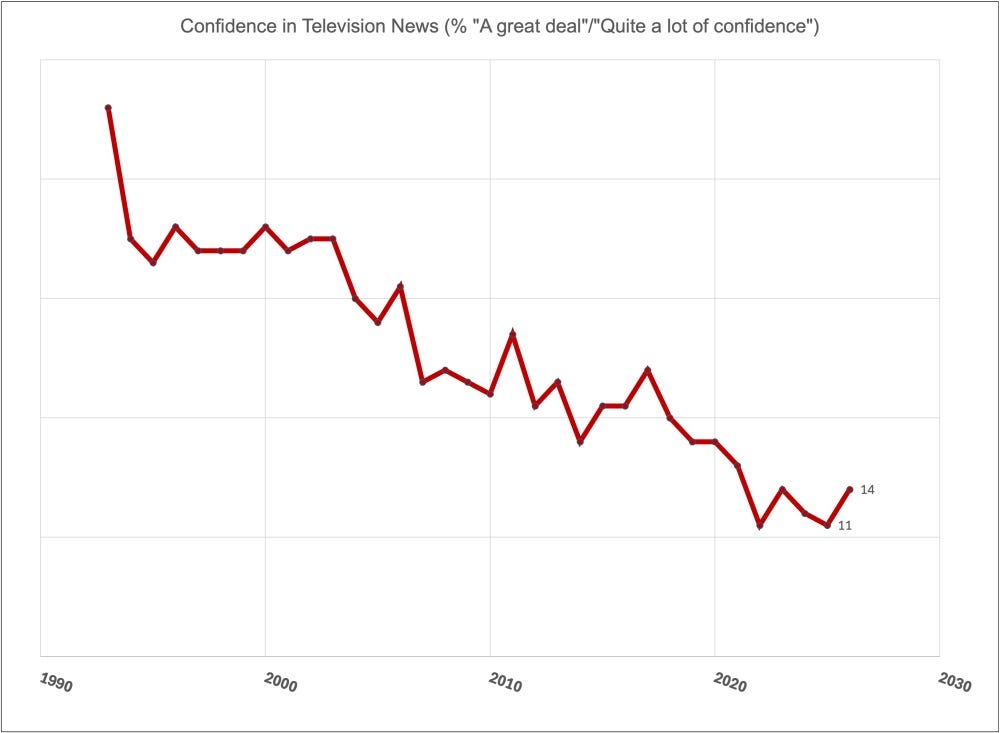
Television news fares even worse, registering at 14 percent. Though this represents a modest three-point increase, it’s nothing to cheer: TV news sits second-to-last on the list, ahead of only Congress, which sits at only 9 percent.
The credibility crisis is even more embarrassing when you realize that both television and newspaper journalism are trusted less than “the medical system” and “banks” — and not by small margins, but by double digits.
Confidence is at or near record lows, and it doesn’t seem we will recover soon.
Even Democrats, the bloc that graded the press most favorably in Gallup’s surveys, rank television and newspaper reporting at only 16 percent and 22 percent, respectively. Republicans and, to a lesser extent, Independents take a much dimmer view. (It may be worth noting that the only institutions where Democratic approval exceeds that of both Republicans and Independents are higher education, public schools, organized labor, and newspapers.)
Can we blame the audience? Can we really say this is anyone’s fault but our own?
Any fair assessment of the current media landscape must acknowledge viewer bias. But bias alone cannot explain the institutional collapse of trust. Audiences have always had preferences. One is therefore forced to confront the possibility that the loss of confidence is largely of the press’s own making. Decades of one-sided, sloppy reporting and a near-total disregard for audience feedback have led us here. If anything, the failings have worsened in recent years.
Just look at some of the coverage from the past few weeks.
In a story about Republicans who claimed to have spoken recently with Sen. Mitch McConnell (R-Ky.), CNN included a tweet from “Rep. Jack Kimble,” who supposedly represents California’s 54th congressional district and co-sponsored “Poe’s Law.”
Except that there is no House member named Jack Kimble, and California has only 52 congressional districts. Also, “Poe’s Law” is an Internet-era adage, not an actual piece of legislation. “Jack Kimble” is a satirical Twitter account.
If you missed that one, perhaps you caught when National Public Radio’s Nina Totenberg falsely reported that Justice Samuel Alito had announced his retirement. She published an entire pre-write, complete with oddly specific future dates and everything. NPR quickly retracted the story, explaining that it had simply taken the 82-year-old beat reporter at her word. Totenberg later said she had misheard Chief Justice John Roberts, who had announced no such thing.
Speaking of justices, if you watch MS Now, you learned last week that President Trump is largely to blame for the Supreme Court’s recent requests for increased security funding — not the dozens of Democratic lawmakers, left-wing activists, or would-be assassins who have threatened and harassed the justices and their families.
“I do think a big part of it is Donald Trump,” said MS Now contributor Mark Stern, “when he has these fits, like he did after the tariffs decision, where he said that some of these justices should be ashamed of themselves and their families should be ashamed of themselves. … That is a not-so-subtle signal to a lot of angry, violent, paranoid people that they need to take matters into their own hands because Trump’s soldiers aren’t delivering for him. It’s not all Trump, but I do think it’s a big part.”
Except it wasn’t a tariffs ruling that inspired the attempted assassination of Justice Brett Kavanaugh. It was the Dobbs decision overturning Roe v. Wade. In fact, Supreme Court Justice Amy Coney Barrett stated specifically during congressional testimony last week that the threats and intimidation “were particularly intense a few years ago around the Dobbs leak,” forcing her to wear a bulletproof vest.
But hey — maybe the swatting of Barrett’s family in May was the work of angry importers. You never know!
Even more embarrassing than MS Now’s historical revisionism is the fact that NBC Nightly News skipped Barrett’s and Justice Elena Kagan’s appearances altogether that evening and instead led with a story about explosive diarrhea. There’s an allegory in there somewhere.
Elsewhere, deeper in the gutters of modern journalism, you have the more honest, if depraved, coverage of the threats against the Supreme Court. This includes a piece published last week by BuzzFeed (yes, it still exists) originally titled, “‘My Heart Is With The Women Who Died Because Of Your Cowardice’: People Have No Sympathy For Amy Coney Barrett After She Revealed The Post-Roe Threats She Received.” The subhead added, “I don’t condone violence, but what did she expect when she took rights away from so many in the blink of an eye?”
Believe it or not, Buzzfeed ultimately felt a need to change the head and the subhead excusing violence against sitting justices.
While we’re on the topic of evil people who believe they are morally superior, PBS News also reminded everyone last week that it is not so much in the business of reporting facts as it is in the business of pushing certain narratives by any means necessary, even to the detriment of clear, basic communication.
If you caught PBS’s interview with ACLU lawyer Chase Strangio, a biological female, you likely noticed that, like the last Japanese soldier of World War II, the network’s hosts remain fiercely committed to normalizing the chemical and surgical alteration of minors, largely through the strategic deployment of the maliciously evasive euphemism “gender-affirming care.”
What is the average, non-radicalized news consumer supposed to make of this? What is he supposed to do with reports that trade straightforward and honest language for clearly ideological euphemism? With listicles that platform anonymous Twitter users celebrating threats against Supreme Court justices as karmic justice? With outright fabrications about phantom retirements and nonexistent members of Congress? With false claims that the president is largely to blame for the Court’s security needs — easily debunked by a cursory Google search?
Decades of inaccurate, one-sided, false, and often incomprehensible reporting, mixed with insularity and unwarranted self-regard, have produced an industry-wide audience exodus. People are starved for anyone who seems even remotely honest and, above all, normal. This evidently excludes a great many professional journalists.
This is nothing to dismiss or laugh off. Nothing else matters if no one trusts us — and right now, no one trusts us.
The greatest crisis in journalism today is this credibility gap. It isn’t AI or social media. It isn’t the decline of local newsrooms.
Whether we take this seriously will determine whether we serve our purpose or fade into irrelevance. Much of the journalism ecosystem is already migrating to podcasts and Substack. It wouldn’t take much for the broader industry to collapse in on itself, leaving behind a small, largely irrelevant subculture whose only remaining audience consists of those seeking constant affirmation of their increasingly niche political pieties.
A version of this story was published originally by The Hill on July 20, 2026.
Just out of high school, more than 50 years ago, I was a copy boy in the newsroom of the Chicago Tribune. My job was to clear the AP, UPI, Knight Ridder, City News Bureau teletypes of the stories of the day and to pass along the carbon copies, of which there were several, to the appropriate editor depending on the subject matter.
To do my job, for eight hours a day, I read every story from every source. Corrections came through as circumstances changed in the event, at which time the editor would cut (with a scissors) and paste (with rubber cement) the new text to the version he sent to composing to go in to the morning edition.
Everyone, from the senior editors to the reporters on the beat worked so hard to get everything right, to get the story straight. I cannot imagine any one of them acting the way the media does now.
Good article, Mr. Adams.
All true, yet the audience is also part of the problem, with our polarized society insisting on demonizing those who view almost any issue differently than they view it themselves. This leads to siloed slices of the overall media audience believing that CNN-NPR-and the rest of their like-minded agents are either completely fair or even skew right. It leads hyper conservatives to only look at right-wing views, distrusting any others. I look at Fox News mostly for headlines, and find they are part of the problem as well, promoting salacious gossip and sensationalizing and exaggerating certain issues to make the left look bad. Where do we find actual balance?